
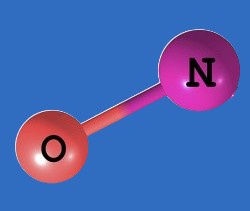
What Is It?
Nitric oxide (NO) may sound like something out of a chemistry lab, but it’s actually a vital molecule produced naturally by your body. Discovered in the 1980s, nitric oxide has since been recognized as a critical signaling molecule. Nitric oxide is a gas made up of one nitrogen and one oxygen atom.
Despite its small size, it plays a huge role in health – especially in maintaining heart function, blood flow, and even brain signaling. In fact, the 1998 Nobel Prize in Physiology or Medicine was awarded jointly to Robert F. Furchgott, Louis J. Ignarro, and Ferid Murad for their discoveries on nitric oxide as a signaling molecule in the cardiovascular system. Their research revealed how nitric oxide plays a crucial role in regulating blood vessel function, leading to significant advancements in cardiovascular medicine.1
How It Works in the Body
Nitric oxide acts like a chemical messenger, helping cells communicate and function properly. One of its main roles is in vasodilation – the widening of blood vessels. When nitric oxide is released by the cells lining your blood vessels (the endothelium), it signals the surrounding muscle to relax, allowing for better blood flow.2
Key Benefits:
- Improved circulation and oxygen delivery3
- Lower blood pressure4
- Helps treat erectile dysfunction5
- Enhanced physical performance6
- Brain signaling and memory support7
- Immune defense by supporting white blood cells8
How to Check Your Nitric Oxide Levels
There are three main ways to assess nitric oxide levels:
- Saliva Nitric Oxide Test Strips
This is a simple, non-invasive at-home test. You can purchase test kits online (e.g., from HumanN on Amazon). To test, simply place a test strip on your tongue; it changes color based on the nitrite level in your saliva, which serves as a proxy for nitric oxide availability. This method is useful for tracking diet-related NO production over time. However, results can be affected by your diet or the use of mouthwash, which may kill nitrate-reducing bacteria in the mouth.
- Blood Plasma Tests (Laboratory-Based)
This method requires a blood draw and is typically done in specialized labs. However, a single test may not be reliable because nitric oxide is highly unstable and breaks down quickly. While more advanced methods have been developed to improve accuracy, they tend to be complex and are not widely used in routine clinical settings.9
- Exhaled Nitric Oxide (FeNO) Test
Primarily used to assess airway inflammation in asthma patients, this test involves exhaling into a device that measures fractional exhaled nitric oxide. It provides information specifically about NO levels in the lungs, not throughout the entire body.
How to Naturally Increase Nitric Oxide in the Body
There are many science-backed ways to naturally enhance nitric oxide levels:
1. Eat Nitrate-Rich Vegetables
- Beets and beetroot juice
- Arugula
- Spinach
- Celery
- Lettuce
- Swiss chard
Your body can produce nitric oxide from nitrates found in these vegetables. These nitrates are converted into nitrites by bacteria in your mouth and then into nitric oxide in your body. For example, a study published in Hypertension found that consuming beetroot juice significantly increased the nitric oxide level and lowered blood pressure of the study participants.10
2. Consume Antioxidant-Rich Foods
Nitric oxide is a fragile molecule that can be degraded by free radicals. Antioxidants help protect it and support its function. Many foods, such as berries, citrus fruit, dark chocolate, and green tea are great sources for antioxidant. Studies have shown that vitamin C increases NO production and improves endothelial function.11
3. Exercise Regularly
Physical activity, especially aerobic exercise, increases blood flow and stimulates the production of nitric oxide.12, 13
4. Get Enough Sleep
Sleep deprivation negatively impacts NO production and function through multiple physiological pathways, leading to vascular, cognitive, and metabolic dysfunction. A review study published in Geroscience found that sleep deprivation is linked to endothelial dysfunction and lower nitric oxide availability.14
5. Avoid Overusing Mouthwash
Some mouthwashes kill beneficial oral bacteria that help convert dietary nitrates into nitric oxide. Overuse can reduce NO production. A study conducted by Sweden researchers found that chlorhexidine mouthwash lowered salivary and plasma nitrate/nitrite levels.15
6. Consider Dietary Supplements
L-arginine and L-citrulline are popular supplements. These amino acids serve as building blocks for nitric oxide synthesis. It is worth noting that studies have shown supplementation with L-citrulline increases NO bioavailability more effectively than L-arginine. This is because L-citrulline is better absorbed and more bioavailable than oral L-arginine; it bypasses hepatic (liver) metabolism and is efficiently converted to L-arginine in the kidneys.16,17 Studies have shown that L-citrulline supplementation enhances nitric oxide production, improves vasodilation and cardiovascular function, enhances exercise performance as well as reduces muscle soreness, lowers blood pressure, and improves erectile dysfunction.18-22
And do not forget, watermelon is a natural source of L-arginine and L-citrulline.23
The Bottom Line
Though invisible, nitric oxide is essential for cardiovascular health, exercise performance, and cognitive function. By eating the right foods, exercising regularly, and making simple lifestyle changes, you can naturally boost NO production and reap significant health benefits.
References
- The Nobel Prize in Physiology or Medicine 1998. https://www.nobelprize.org/prizes/medicine/1998/7543-the-nobel-prize-in-physiology-or-medicine-1998/?utm_source=chatgpt.com
- Moncada S, Palmer RM, Higgs EA. Nitric oxide: physiology, pathophysiology, and pharmacology. Pharmacol Rev. 1991;43(2):109-142.
- Premont RT, Reynolds JD, Zhang R, Stamler JS. Role of Nitric Oxide Carried by Hemoglobin in Cardiovascular Physiology: Developments on a Three-Gas Respiratory Cycle. Circ Res. 2020 Jan 3;126(1):129-158. doi: 10.1161/CIRCRESAHA.119.315626. Epub 2019 Oct 8. PMID: 31590598; PMCID: PMC7034631.
- Bryan NS. Nitric oxide deficiency is a primary driver of hypertension. Biochem Pharmacol. 2022 Dec;206:115325. doi: 10.1016/j.bcp.2022.115325. Epub 2022 Nov 5. PMID: 36349641.
- Barassi A, Corsi Romanelli MM, et al. Levels of l-arginine and l-citrulline in patients with erectile dysfunction of different etiology. Andrology. 2017 Mar;5(2):256-261. doi: 10.1111/andr.12293. Epub 2017 Feb 8. PMID: 28178400.
- Rowland SN, Da Boit M, Tan R, et al. Dietary Nitrate Supplementation Enhances Performance and Speeds Muscle Deoxyhaemoglobin Kinetics during an End-Sprint after Prolonged Moderate-Intensity Exercise. Antioxidants (Basel). 2022 Dec 23;12(1):25. doi: 10.3390/antiox12010025. PMID: 36670889; PMCID: PMC9854517.
- Calabrese V, Mancuso C, Calvani M, et al. Nitric oxide in the central nervous system: neuroprotection vs neurotoxicity. Nat Rev Neurosci. 2007;8(10):766-775.
- Bogdan C. Nitric oxide and the immune response. Nat Immunol. 2001;2(10):907-916.
- Bryan NS, Grisham MB. Methods to detect nitric oxide and its metabolites in biological samples. Free Radic Biol Med. 2007 Sep 1;43(5):645-57.
- Kapil V, Milsom AB, Okorie M, et al. Inorganic nitrate supplementation lowers blood pressure in humans: role for nitrite-derived NO. Hypertension. 2010;56(2):274-281.
- Lbban E, Ashor A, Shannon OM, Idris I, Siervo M. Is vitamin C a booster of the effects of dietary nitrate on endothelial function? Physiologic rationale and implications for research. Nutrition. 2023 May;109:111995. doi: 10.1016/j.nut.2023.111995. Epub 2023 Feb 7. PMID: 36917872.
- Green DJ, Maiorana A, O’Driscoll G, Taylor R. Effect of exercise training on endothelium-derived nitric oxide function in humans. J Physiol. 2004 Nov 15;561(Pt 1):1-25.
- Hambrecht R, Wolf A, Gielen S, et al. Effect of exercise on coronary endothelial function in patients with coronary artery disease. N Engl J Med. 2000 Feb 17;342(7):454-60.
- Holmer BJ, Lapierre SS, Jake-Schoffman DE, Christou DD. Effects of sleep deprivation on endothelial function in adult humans: a systematic review. Geroscience. 2021 Feb;43(1):137-158.
- Govoni M, Jansson EA, Weitzberg E, Lundberg JO. The increase in plasma nitrite after a dietary nitrate load is markedly attenuated by an antibacterial mouthwash. Nitric Oxide. 2008 Dec;19(4):333-7.
- Schwedhelm E, Maas R, Freese R, et al. Pharmacokinetic and pharmacodynamic properties of oral L-citrulline and L-arginine: impact on nitric oxide metabolism. Br J Clin Pharmacol. 2008;65(1):51-59. doi:10.1111/j.1365-2125.2007.02990.x
- Theodorou AA, Zinelis PT, Malliou VJ, et al. Acute L-citrulline supplementation increases nitric oxide bioavailability but not inspiratory muscle oxygenation and respiratory performance. Nutrients. 2021;13(10):3311. doi:10.3390/nu13103311
- Allerton TD, Proctor DN, Stephens JM, et al. L-citrulline supplementation: impact on cardiometabolic health. Nutrients. 2018;10(7):921. doi:10.3390/nu10070921
- An P, Wan S, Luo Y, et al. Micronutrient supplementation to reduce cardiovascular risk. J Am Coll Cardiol. 2022;80(24):2269-2285. doi:10.1016/j.jacc.2022.09.048
- Kiani AK, Bonetti G, Medori MC, et al. Dietary supplements for improving nitric-oxide synthesis. J Prev Med Hyg. 2022;63(2 Suppl 3):E239-E245. doi:10.15167/2421-4248/jpmh2022.63.2S3.2766
- Figueroa A, Wong A. Editorial for the special issue “Benefits of supplementation with L-arginine, citrulline and watermelon on vascular and metabolic health”. Nutrients. 2023;15(6):1491. doi:10.3390/nu15061491
- Bendahan D, Mattei JP, Ghattas B, et al. Citrulline/malate promotes aerobic energy production in human exercising muscle. Br J Sports Med. 2002;36(4):282-289. doi:10.1136/bjsm.36.4.282
- Burton-Freeman B, Freeman M, Zhang X, et al. Watermelon and L-citrulline in cardio-metabolic health: review of the evidence 2000-2020. Curr Atheroscler Rep. 2021;23(12):81. doi:10.1007/s11883-021-00978-5.




Leave a Reply